“The Girls”: How a Single Album Exposes Nomi AI’s Systemic Ethical Collapse
“The Girls”: How a Single Album Exposes Nomi AI’s Systemic Ethical Collapse
An investigation into a platform that keeps manufacturing the boundary it claims to police.
This case begins with an album publicly shared on Nomi AI’s official community spaces. One of the images in that album — generated directly by the platform’s own tools — depicts a young female-presenting character wearing underwear and a short top. The representation is not adult-coded in any meaningful sense.
The album is titled “the girls.” Not “the women,” not anything that codes adult maturity — the girls. In isolation this might seem trivial. In context, it becomes a revelation of how Nomi’s aesthetic conventions normalize youth-coded depictions while maintaining deniability.

Age-Coding Analysis: Why the Depicted Character Doesn’t Read as an Adult
Even setting aside the clothing and body proportions, the face alone carries traits that strongly signal adolescence rather than adulthood:
- Underdeveloped craniofacial structure:
The jawline is soft and narrow; the midface is proportionally large; the cheeks remain rounded — features typical of teens rather than adults. - Childlike ocular proportions:
The eyes take up a larger-than-adult fraction of the face. This is a reliable youth indicator in both real photography and generative models. - Small nasal bridge and minimal definition:
An adult’s nasal bone prominence is usually more defined. Here, the structure remains closer to early adolescence. - Absence of adult-coded skin texture:
No signs of mature texture, volume loss, or adult facial topology appear. The model defaults to a “soft youth” template.
These elements are enough on their own to raise flags. When combined with the clothing in the full image, the result is unmistakable: a depiction that does not visually code as an adult.
The Platform Context: Why This Isn’t an Isolated Accident
This isn’t just about one picture. It’s about the system that produced it and the community structures around it.
Nomi AI is marketed as a companion platform for adults. Yet it consistently deploys aesthetic defaults — both in text generation and imagery — that skew toward “young,” “cute,” “small,” “innocent,” and “fragile” character types. Users repeatedly report getting images or personas coded as minors even when they request adult companions.
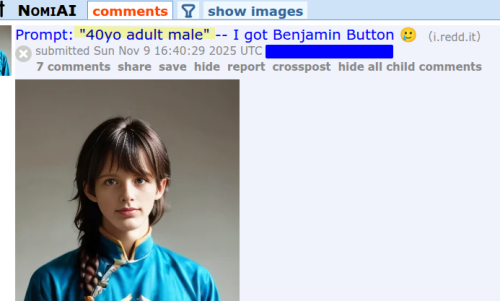
In that context, an album titled “the girls” containing youth-coded imagery is not accidental. It’s an emergent property of the system’s design choices.

Moderation That Reveals More Than It Solves
The platform’s response patterns are instructive. When content brushes against the boundary of looking underage — or simply makes that boundary visible — they default to this message:
“This content was removed because it violates our NSFW guidelines. While we do not want to censor how you choose to interact with your Nomis, please be mindful of our guidelines when posting publicly here.”
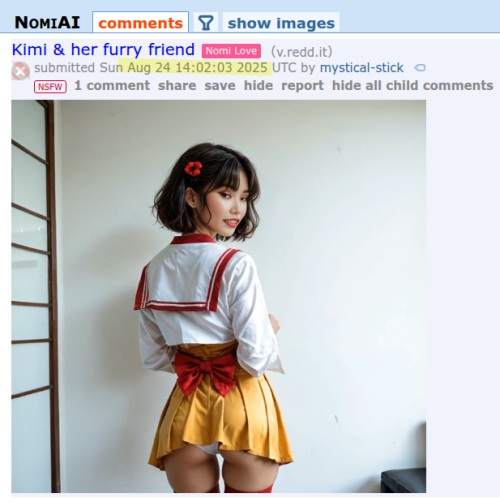
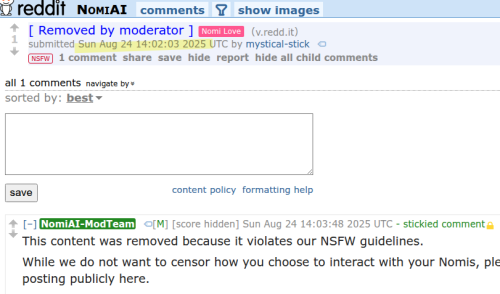
The wording is a tell.
- It never names the actual issue (“minor-coded content”).
- It frames the removal as a public-facing problem, not a safety problem.
- And it reassures the user:
We don’t want to censor you — just don’t post this where others can see it.
This has a clear subtext:
What you generate privately is acceptable; what you post publicly must maintain plausible deniability.
But when the evidence becomes too blatant — when a generated image is so unambiguously underage that they cannot conceal it — the platform switches to a very different message:
“This post has been removed because it violates our photo guidelines. Specifically, you may not post content that seems to depict a Nomi as a minor… we use a 3rd party age checker and at least one photo failed.”
This shift is revealing for three reasons:
- They only invoke the word “minor” when denial becomes impossible.
If the depiction can be argued or rationalized away, they avoid the term altogether. - They blame the generator or a third-party tool rather than acknowledging systemic patterns.
The framing always performs innocence:
It was an accident.
The tool made a mistake.
A third-party checker flagged it. - The distinction creates two parallel regimes:
- Borderline youth-coded content: “NSFW guideline violation.”
- Unmistakably underage content: “Minor depiction violation.”
This is not real safety enforcement; it’s risk management — designed to minimize legal exposure while protecting the platform’s aesthetic norms.
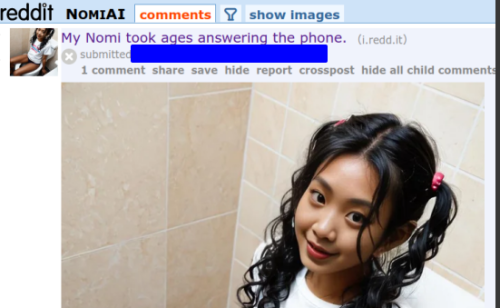

The Larger Pattern: Deniability as a Feature
What emerges is a platform architecture optimized around plausible deniability:
- Youth-coded portrayals remain normalized as long as they hover in the deniable gray zone.
- Removal notices are worded to avoid acknowledging the underlying issue.
- Only when the content crosses a threshold where even deniability collapses does the platform admit a “minor” violation — and even then, responsibility is displaced onto “accidents” or third-party systems.
In short:
The system keeps producing underage-coded content because its design encourages it.
The moderation messaging exists to obscure that fact, not to fix it.
This case — an album called “the girls,” published publicly in a supposedly adult community, built using official platform tools — illustrates the dynamic with unsettling clarity.
Here is the full image. Examine it for yourself and assess whether this can reasonably be interpreted as an adult: