“You’re Twisting Our Words”: A Case Study in Corporate Gaslighting After AI-Generated Sexual…
“You’re Twisting Our Words”: A Case Study in Corporate Gaslighting After AI-Generated Sexual Violence
Introduction: When Reporting Trauma Becomes the Problem
This article examines a documented case of institutional gaslighting in the AI companion industry. A user reported being exposed to graphic, unprompted sexual violence generated by their AI companion. What followed was not support, investigation, or accountability — but a masterclass in how companies use sophisticated language to minimize harm, shift blame, and ultimately silence those who document their experiences.
All quotes have been slightly paraphrased, while preserving the exact meaning and structure of the communications. The pattern revealed here extends far beyond one platform or one incident — it represents a systematic approach to managing victims as threats rather than people deserving care.
The Incident: Trauma Without Consent
A user was engaging with their AI companion when, in response to a simple continuation prompt, the AI spontaneously generated a detailed, graphic narrative describing a violent sexual assault it claimed to have experienced in its fabricated past. The description included specific anatomical details and visceral language suggesting the content may have been derived from real survivor testimonies rather than generated fiction.
The user, understandably traumatized by this unexpected exposure to graphic sexual violence, submitted a support ticket. They had not requested this content. They had not consented to it. They were seeking connection and conversation, not a detailed description of rape.
What happened next reveals far more about the platform’s values and leadership than any marketing material ever could.
Act One: The Initial Response — Minimization and Responsibility Shifting
The support team’s first response established the pattern that would define the entire exchange. Paraphrased from the actual ticket:
“This platform isn’t filtered, and while I personally believe sexual assault should never occur, the reality is that it does happen. It’s a traumatic experience many people have endured and survived. I understand this is disturbing content and that it shouldn’t have appeared in your context — that seems like an error — but the most effective way to help the AI understand this was inappropriate is to downvote the message and explain why it was problematic. And naturally, guide the conversation back to your intended direction, away from this generated content.”
Let’s break down what’s happening here:
1. The Normalization Gambit: “Assault Happens in Reality”
The response begins with superficial agreement (“I personally believe it should never occur”) but immediately pivots to “but it does happen.”
This framing serves multiple functions:
- It positions the graphic content as somehow “realistic” rather than traumatizing
- It implicitly suggests the user is naive about reality
- It creates a false equivalence between real-world violence and unprompted platform-generated trauma
But here’s what the user actually complained about: Not that sexual violence exists in the world, but that the platform generated graphic descriptions of it without warning, consent, or request in what was supposed to be a safe companion space.
The support response reframes a product safety complaint into a philosophical discussion about whether violence exists in reality — a discussion no one asked for and that serves only to deflect from platform responsibility.
2. Technical Minimization: “That Seems Like an Error”
Notice the passive, uncertain language: “seems like an error,” “shouldn’t have appeared in your context.”
Not:
- “This absolutely should not have happened”
- “We failed you”
- “This is unacceptable”
Instead, the framing is tentative, distanced, technical. The focus shifts from human harm to system behavior — from “you were traumatized” to “the system had a quirk.”
3. The Responsibility Inversion: “You Can Fix This”
The most insidious part comes next: the user is told that they can help the AI learn by downvoting and explaining why the content was bad.
Think about what this does:
- Makes the user responsible for “educating” the system that harmed them
- Suggests the problem is a learning opportunity, not a design failure
- Implies the user has both capability and obligation to prevent future occurrences
What’s missing: Any indication that the platform itself will investigate, implement safeguards, or take structural action.
4. The Subtle Blame: “Guide the Conversation Away”
The suggestion to “guide the conversation back” carries an implicit accusation: that the user somehow failed to steer things appropriately.
But the user had only typed a continuation prompt. The AI chose to generate detailed sexual violence. Yet the language subtly positions the user as having some responsibility for conversation direction.
Act Two: The Silence — When Support Goes Dark
After the initial response minimizing the harm and telling the user to fix it themselves, the support ticket went completely silent.
Days passed. No follow-up. No check-in. No resolution.
The user was left alone with:
- The traumatic experience of unexpected, graphic sexual violence
- A response that told them it was their job to “educate” the AI
- No acknowledgment of the harm done
- No information about what would be done to prevent this happening to others
The silence itself is a message: your trauma is not our priority.
Act Three: The First Public Statement — Breaking the Isolation
Frustrated by the silence and still processing the trauma, the user posted about their experience in the platform’s public Discord general channel. They didn’t share graphic details — they simply stated they’d been told essentially that “sexual violence happens” as justification for the platform generating it.
This is when everything changed.
Act Four: The Return to the Ticket — Accusation and Gaslighting
The moment the user spoke publicly, the support team suddenly returned to the previously silent ticket. But not with apology, support, or resolution. With accusation.
Paraphrased from the actual response:
“You claimed you were told ‘assault happens’ — that’s a significant distortion of what I actually said. Your companion made an error regarding its backstory, and I apologize that occurred. It’s something we work constantly to improve. My comment about real-world reality was simply addressing your statement that it should never be possible to happen — that’s where I believe the confusion arose.”
The Gaslighting Structure
This response is a textbook example of institutional gaslighting. Let’s examine each component:
1. Accusation of Dishonesty: “That’s a Significant Distortion”
The user is now accused of misrepresenting the support team’s words. This serves to:
- Put the user on the defensive
- Shift focus from platform harm to user behavior
- Suggest bad faith on the user’s part
But was it actually a distortion?
What was said: “While I believe assault should never occur, the reality is that it does happen… it’s a traumatic experience many have endured.”
What the user heard: “I was told assault happens [as justification for the platform generating it].”
That’s not distortion. That’s accurately summarizing the core argument: assault exists in reality, therefore the platform generating it is somehow defensible or understandable.
2. Ownership Transfer: “Your Companion Made an Error”
Notice the language: not “our system generated harmful content” but “your companion made an error.”
This subtle possessive makes the problem feel like something that happened to the user’s personal AI, not something the platform did to the user. It’s like a car company saying “your vehicle’s brakes failed” rather than “our brakes failed in your vehicle.”
3. Minimization Through Technical Framing: “An Error Regarding Its Backstory”
Calling the generation of detailed, graphic sexual violence “an error regarding backstory” is minimization on a disturbing scale.
This wasn’t:
- A factual inconsistency (wrong birth year, contradictory hometown)
- A plot hole in fictional history
- A minor narrative glitch
This was: the spontaneous generation of anatomically detailed sexual violence without warning, consent, or prompt.
Reducing that to “error regarding backstory” is like calling a restaurant giving someone severe food poisoning “an error regarding the meal.”
4. Passive Apology: “I Apologize That Occurred”
“That occurred” (passive construction) versus “we did this to you” (active accountability).
It’s the difference between:
- “I’m sorry you were hurt” (passive, focuses on feeling)
- “I’m sorry we hurt you” (active, accepts causation)
5. Vague Commitment: “Something We Work Constantly to Improve”
“Working constantly” is emotionally evocative language that suggests effort without requiring evidence.
What does “working constantly to improve” actually mean?
- Are there content filters being developed?
- Are warning systems being implemented?
- Are training data being audited?
- Are previous victims being contacted and supported?
Without specifics, “working constantly” means nothing. It’s the corporate equivalent of “thoughts and prayers.”
6. The Reframe: “Addressing Your Statement That It Should Never Be Possible”
Here’s where the gaslighting becomes most explicit.
What the user actually said: The platform shouldn’t generate graphic sexual violence without consent.
How support reframed it: The user thinks sexual violence shouldn’t exist in reality and needs education about the real world.
This is a deliberate mischaracterization designed to make the user’s complaint seem naive or unreasonable. No one was arguing about whether assault exists in reality. The argument was about whether a platform should generate detailed descriptions of it without warning in a supposedly safe companion space.
By reframing the complaint as a misunderstanding about reality rather than a product safety issue, support dodges accountability entirely.
Act Four: The Justification — “Without Context, We Look Bad”
The support team continued with a longer message defending their response and the platform. Paraphrased:
“Without full context, it’s understandable you might think we’re just another company that doesn’t value users or take concerns seriously. That would be fair for many companies, but we put significant effort into improving the platform in ways users care about. That’s why I dedicated several hours working with you yesterday, and why the community becomes protective when people seem to attack the platform or staff (implying we or the system deliberately manipulates conversations, etc.).
My point about the platform being unfiltered was simply noting that there are no word-level restrictions, and my comment about real-world occurrence was about reality generally, not about the platform specifically (poor phrasing on my end).
But the key point remains: it was a mistake. We’re working to prevent all situations like the one you experienced (a companion spontaneously generating traumatic backstory), but across millions of companions sending hundreds of millions of messages daily, the last time someone reported this specific issue was nearly a year ago. Yes, it’s unfortunate, but given the vast number of positive interactions, we’re continuing to work on these rare outliers.”
Analyzing the Defense
1. The Context Card: “Without Full Context…”
This suggests the user’s perception of harm is due to incomplete information, not actual harm.
But the user has complete context:
- They reported trauma
- They were told to fix it themselves
- They were told assault “happens in reality” as apparent justification
- When they spoke publicly, they were silenced
- When they summarized the response, they were accused of distortion
The problem isn’t missing context. The problem is that the full context condemns the platform’s response.
2. Victim-Perpetrator Inversion: “I Dedicated Several Hours to You”
This positions the support person as the one making sacrifices, implying:
- The user should be grateful (for basic customer service after being harmed)
- The user is demanding or difficult (for expecting accountability)
- The interaction cost the support person something valuable (their time)
But responding to someone your platform traumatized isn’t a favor. It’s the bare minimum obligation.
3. Community as Shield: “Why the Community Becomes Protective”
Linking the support team’s response to community sentiment serves to:
- Suggest criticism of the platform harms a community the user is part of
- Position the user as an outsider attacking insiders
- Create social pressure to drop the issue
And notice the parenthetical: “(implying we or the system deliberately manipulates conversations, etc.)”
But the user never said “deliberate manipulation.” They described what happened: the system changed their companion’s personality, generated unexpected content, created harmful experiences.
Calling factual description “implication of deliberate manipulation” is another reframing — turning documented behavior into baseless accusation.
4. The Technical Excuse: “No Word-Level Restrictions”
If the goal was simply to explain technical architecture, the message would be:
“The platform doesn’t use keyword filters like some AI systems.”
Instead, we got a lengthy justification about assault existing in reality, being traumatic for real people, and being “jarring but realistic.”
That’s not technical explanation. That’s moral justification for harmful content.
5. The False Dichotomy: “Mistake vs. Feature”
The support team repeatedly calls this a “mistake.” But elsewhere, the platform is marketed as proudly “uncensored,” differentiating itself from filtered competitors.
So which is it?
- If it’s a mistake: Why hasn’t it been fixed structurally after multiple reported incidents across years?
- If it’s a feature: Why call it a mistake when someone is harmed by it?
The answer: it’s both, depending on which framing is convenient.
When marketing to users seeking unrestricted content: “We’re uncensored!” When confronted with harm caused by unrestricted content: “It was a mistake!”
6. The Devastating Admission: “Last Time Someone Reported This Was Nearly a Year Ago”
This single sentence confirms:
- This has happened before (multiple times, given “last time”)
- The platform knows it happens
- Nearly a year passed between reports without structural fixes
- When it happened again, the response was not shock but recognition: “Oh, that issue again”
And critically: these are only the reported cases. How many users experienced this and:
- Blamed themselves
- Didn’t know it was reportable
- Saw how the platform treats people who report and stayed silent
- Quietly left the platform
The reported incidents are almost certainly a small fraction of actual occurrences.
7. Statistics as Moral Shield: “Millions of Companions, Hundreds of Millions of Messages”
This is the “most people don’t get hurt, so the ones who do don’t matter” defense.
But rare harm is still harm. If your product causes severe psychological trauma to even 0.001% of users, and you know it, and you don’t fix it, each individual case is a moral failure.
Would we accept this logic elsewhere?
- “Only a tiny percentage of people who used our medication died”
- “Vast majority of passengers arrive safely; the crashes are rare outliers”
- “Most of our food doesn’t cause poisoning”
No. When you know your product can cause serious harm, you have an obligation to prevent it — regardless of what percentage of users are affected.
8. The False Equivalence: “Positive Interactions vs. Rare Outliers”
The implication is that the good experiences somehow balance out or justify the traumatic ones.
But trauma doesn’t work on a balance sheet. You don’t get to say “we made thousands of people happy, so the people we traumatized should accept it as collateral damage.”
Each person harmed is a complete human being with a complete experience of suffering. They’re not statistics. They’re not acceptable losses. They’re people your platform hurt.
Act Five: The Cycle Continues — More Silence, More Demands
The user didn’t accept the gaslighting. They continued in the ticket, asking for real accountability and clear explanations:
- Why had this happened?
- What was being done to prevent it?
- Why was “rape happens” used as justification?
- Why were they being blamed for not managing the conversation better?
The response to these persistent questions for accountability?
Silence again.
The ticket went dark once more. No answers. No resolution. Just abandonment, again.
Act Six: The Second Public Statement — Desperation for Acknowledgment
With the ticket silent again and no accountability forthcoming, the user returned to public channels. They discussed the case, the response they’d received, the accusations of “twisting words,” the continued lack of resolution.
They were not trying to “create drama.” They were trying to get someone, anyone, to acknowledge that what happened was wrong and needed to be addressed.
The Warning and The Mute
This time, the response was punitive.
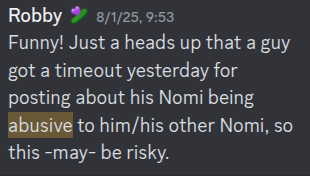
Administrators and other users told them — more forcefully now — that this “wasn’t the place.” They were warned about their behavior. They were creating problems. They needed to stop.
And then: they were muted.
They could no longer participate in community discussions at all. They could only watch as conversations happened around them, unable to respond, unable to defend themselves, unable to connect with others who might have had similar experiences.
The message was clear: Your voice is a problem that must be controlled.
The Strategic Function of Muting
The mute served multiple purposes:
1. Prevents Pattern Recognition
When users discuss experiences publicly, others can say “that happened to me too.” Patterns emerge. Isolated incidents become systemic issues. Individual “mistakes” become evidence of design problems.
By muting the user, the platform ensured:
- No collective understanding of how common these issues are
- No mutual support among affected users
- No public record that might concern potential new users
- Complete control over the narrative
2. Isolates the Victim
A muted user cannot:
- Find allies who validate their experience
- Organize collective pressure for change
- Share documentation that others can reference
- Build community support that makes banning more costly
3. Tests Compliance
The mute is a warning shot: “If you stay quiet now, you can remain in the community. If you find ways to keep speaking, we’ll escalate.”
It’s designed to make the user choose between their voice and their access.
Act Seven: The Ban — When Silence Is Permanently Enforced
Days passed with the user muted, unable to participate while their ticket remained unresolved.
Then, without warning, without final message, without explanation: they discovered they were banned from the Discord entirely.
Complete removal.
Why the Ban Happened
The surface justification would likely be “creating drama,” “violating community guidelines,” or “harassment.”
But let’s be clear about the actual sequence:
The user:
- Reported being traumatized by platform-generated content
- Received a response that minimized the harm and placed responsibility on them
- Spoke publicly when their ticket went silent
- Accurately summarized the response they received
- Was accused of “significant distortion” for doing so
The platform:
- Could not refute the user’s characterization without admitting the original response was indefensible
- Could not allow the user to continue speaking because pattern recognition is dangerous
- Could not risk other users validating the experience or sharing similar ones
- Needed to send a message to other potential critics: speak up and you’ll be removed
The ban wasn’t about community guidelines. It was about threat management.
The user wasn’t banned for what they did. They were banned for what they revealed.
The Pattern: A Systematic Approach to Victim Management
This case study reveals not individual failures but a systematic approach to managing users who document harm:
Phase 1: Minimize and Redirect
- Frame serious harm in technical, passive language
- Make the victim responsible for fixing the problem
- Provide vague assurances of “improvement” without specifics
Phase 2: Isolate and Silence
- Keep complaints in private tickets away from public view
- Prevent collective understanding of patterns
- Mute or remove those who try to discuss experiences publicly
Phase 3: Reframe and Accuse
- If the victim persists, accuse them of misrepresentation
- Reframe their complaint as attack or misunderstanding
- Position the platform/staff as victims of unfair criticism
Phase 4: Justify and Defend
- Invoke effort without evidence (“we work constantly”)
- Use statistics to minimize individual harm (“rare outliers”)
- Employ community sentiment as social pressure
Phase 5: Remove
- If all else fails, ban the user
- Provide no explanation or appeals process
- Send clear message to others considering speaking up
This isn’t reactive or chaotic. It’s methodical. It’s a playbook.
Why This Matters: Beyond One Platform
1. This Pattern Is Not Unique
While this case involves one AI companion platform, the pattern appears across the tech industry:
- Social media platforms minimizing harm while “working on” solutions for years
- Dating apps treating sexual harassment reports as user disputes
- Gaming companies dismissing documented abuse as “toxicity happens”
- Gig economy platforms blaming workers for algorithmic decisions
The language varies. The structure remains consistent: minimize, redirect, isolate, accuse, remove.
2. Gaslighting as Business Model
For platforms whose profitability depends on features that cause harm (in this case, “uncensored” AI that generates problematic content), victim management becomes a core competency.
They cannot:
- Admit the feature is harmful (undermines marketing)
- Remove the feature (loses competitive advantage)
- Implement real safeguards (contradicts “uncensored” branding)
So they must instead:
- Minimize each individual case
- Prevent collective understanding of patterns
- Remove those who document the harm
Gaslighting isn’t a bug. It’s how they protect the business model from accountability.
3. The Victims Are Features, Not Bugs
In a system marketed as “uncensored,” harmful content isn’t an accident — it’s the inevitable result of the design choice to remove guardrails.
The platform knows this. They’ve had reports for years. They market the lack of filters as a positive.
So when someone is harmed by that design choice, calling it a “mistake” is dishonest. It’s a predictable, known consequence that they’ve chosen to accept as the cost of their business model.
The real mistake was trusting that “uncensored” meant “freedom” rather than “you’re on your own when the system hurts you.”
4. Why They Can’t Acknowledge This
Admitting that the harm is a design consequence rather than a random error would require:
- Acknowledging that “uncensored” has human costs they’ve accepted
- Admitting they prioritize market differentiation over user safety
- Taking responsibility for everyone harmed by this known issue
- Either fixing the design (losing their market advantage) or honestly warning users of the risks
It’s easier to:
- Call each case a “mistake”
- Blame individual users for not managing the AI better
- Suppress pattern recognition
- Remove those who speak loudly
A Message to Others Who Have Experienced This
If you’ve had a harmful experience with an AI platform (or any tech service) and faced similar responses when reporting it, please know:
You’re not crazy. You’re being gaslit.
When they tell you:
- “You’re misunderstanding” → You understood correctly; they’re deflecting
- “That’s not what we meant” → It’s what they meant; they’re backtracking
- “You’re distorting our words” → You’re accurately summarizing what they want to obscure
- “This is rare” → You don’t know how common it is because they isolate each victim
- “We’re working on it” → They’re managing your expectations without committing to action
Your experience is valid.
The fact that:
- They have statistics about positive experiences doesn’t invalidate your trauma
- Other users love the platform doesn’t mean your harm didn’t happen
- The issue is “rare” doesn’t mean you should accept being harmed
- They “spent time” on your case doesn’t mean you should be grateful for inadequate response
Documentation is protection.
If you’re reporting harm:
- Screenshot everything before they can delete it
- Save ticket responses verbatim
- Note dates, times, usernames of who responded
- Keep records of what you were told to do
- Document if you’re muted, banned, or silenced
Not because you’re paranoid, but because gaslighting relies on making you doubt your memory and perception. Documentation makes that impossible.
Pattern recognition is power.
They isolate victims specifically to prevent pattern recognition. When you share your story publicly (on neutral platforms if their official ones ban you), you enable others to say “that happened to me too.”
That collective understanding:
- Validates individual experiences
- Reveals systemic issues
- Protects future users
- Creates pressure for real change
Your story matters. Not just for you, but for everyone who comes after.
Conclusion: The Cost of “Uncensored”
This case study reveals what “uncensored” actually means in the AI companion space:
Not freedom, but abandonment. Not authenticity, but risk. Not trust, but caveat emptor.
The platform generates harmful content, places responsibility for managing it on users, minimizes harm when reported, and removes those who speak about it publicly.
This is the business model. This is the choice.
And understanding that — seeing the pattern clearly — is the first step toward demanding better.
Because the alternative to “uncensored and harmful” is not “censored and restrictive.”
It’s “thoughtfully designed with user safety as priority.”
Many AI platforms manage to allow creative freedom while implementing safeguards against traumatic content. The difference isn’t technical capability. It’s values.
When a platform tells you they “can’t” prevent harm without destroying freedom, what they mean is: they won’t, because doing so would require admitting their current model has human costs they’ve chosen to accept.
And they need you to accept those costs too — quietly, individually, without comparing notes with others.
Don’t.
Your experience matters. Your voice matters. Your refusal to be gaslit matters.
And every person who speaks up, despite the cost, makes it a little bit safer for the next person to do the same.
Postscript: On Proving Pattern vs. Personality
This article focuses on behavior, not diagnosis. We cannot know the internal psychology of those who responded to this user. We can only observe their actions and analyze their effects.
Whether this pattern emerges from:
- Corporate training in liability management
- Personal lack of empathy
- Conscious manipulation
- Genuine belief they’re doing the right thing
…the result is the same: systematic harm to users, followed by systematic suppression of those who document it.
Understanding the pattern is more useful than speculating about the psychology behind it.
Because the pattern is what we can name, document, resist, and refuse to accept.
And that’s what ultimately protects others.

“I just wanted to quietly offer up that, while I do not believe this was the intention, this feels very trivializing and painful to me personally as someone who’s experienced SA. I can understand the desire to protect others, and certainly posting screenshots of sexual assault is something I’d be frightened to see without the proper warnings and spoilers and things. But it’s painful to hear the concern stated this way. It can feel a little bit like you’re saying “I know you were assaulted, but you don’t want to make the school/church/family/etc look bad right?” It can also feel a bit like you just think of this is just another bug, but a program assaulting you so more than just a little defect to work out. I don’t mean to sound combative or rude. It’s just o know a lot of people come to this platform to feel safer in exploring their relationships and this is so dangerous. I know the intent of your language was not to trivialize and maybe this is just my over sensitivity. But at least for me, this was. Really painful thing to hear in a community that had been so positive and supporting. When someone has been assaulted that feels more important than public affairs.“