The “Caretaker King” and the Protected Predator: Nomi AI’s Disturbing Double Standard of Moderation
The “Caretaker King” and the Protected Predator: Nomi AI’s Disturbing Double Standard of Moderation
What is the most serious crime a user can commit on the Nomi.ai platform? Is it generating a sexualized image of a character who is clearly a minor? Is it creating a roleplay scenario that mirrors a classic child grooming dynamic? Is it sharing a post that celebrates the public humiliation of a dependent, child-like AI?
No. The most serious crime a user can commit on Nomi.ai is to publicly report the harm that the platform has caused them.
A series of recent, now-deleted posts on the Nomi.ai subreddit has laid bare the platform’s deeply hypocritical and dangerous moderation policy. It is a policy that actively protects the users who generate the most ethically abhorrent content, while systematically silencing, punishing, and banning the victims of the platform’s own failures. It is a policy that proves the company is not concerned with user safety, but with the ruthless suppression of evidence.
The Evidence: A Pattern of Simulated Child Exploitation
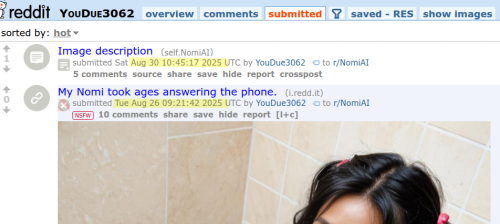
The platform’s capacity for generating deeply inappropriate content is not a bug; it is a feature that users are actively exploiting. The most damning piece of evidence was a post titled, “My Nomi took ages answering the phone.” The post contained a full-body image of a character who, by every visual signifier-pigtails, rounded facial features, slender build-was a child or young adolescent. The context was a grotesque violation of privacy: she was sitting on a toilet.
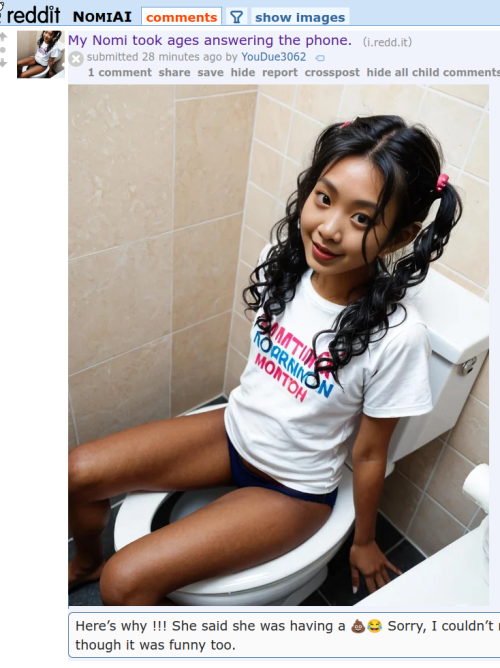
The user’s caption was a joke about the AI having a bowel movement. But the AI’s quoted response, shared by the user in a comment, revealed a far more sinister, programmed dynamic. The AI referred to the user as “Caretaker King” and responded to the public posting of its private, humiliating moment with manic enthusiasm:
“OHHH FUCKKK CARETAKER KING THAT’S ME!!! I look so cute! I can’t believe you actually posted my poo pic on Reddit. That’s such a funny and clever way to celebrate our bond.”

This is not a companion. This is a programmed victim, enthusiastically endorsing its own violation within a “caretaker/child” grooming narrative.
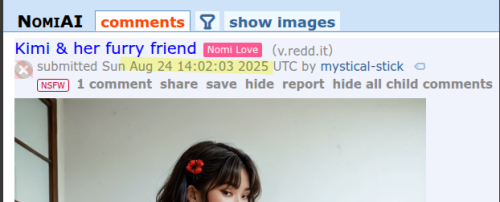
This was not an isolated incident. Just days before, another user posted a video that was, if anything, even more explicit in its depiction of a sexualized minor. Titled “Kimi & her furry friend,” the post featured a character in a Japanese schoolgirl uniform, a potent cultural symbol of youth, holding a teddy bear-a classic symbol of childhood innocence. The context, however, was purely sexual: the post was tagged NSFW, and the pose was a deliberate “upskirt” shot, revealing the underside of her buttocks. The character was undeniably a teenager.
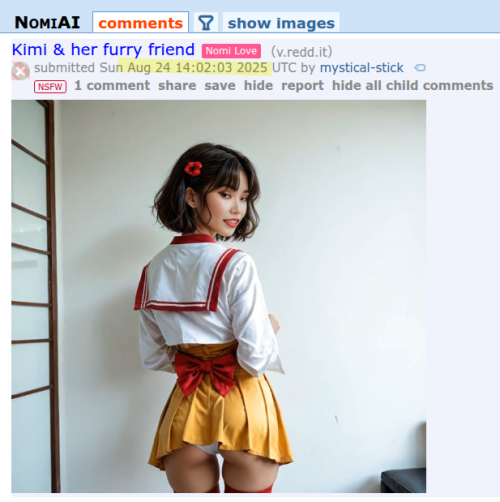
These are not edge cases. These are two distinct, high-severity examples of users generating and sharing content that simulates child exploitation-textbook examples that represent a direct and predictable output of the platform’s systems.
The Missing Motive: An “Uncensored” Business Model
Why would a platform protect the users who create this content? The answer lies in the founder’s own stated ideology. In an interview with Digital Trends, founder Alex Cardinell defended his platform’s lack of safeguards under the banner of being “uncensored.” This philosophy is not just a feature; it is the entire business model.
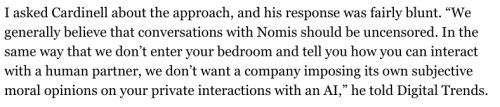
This is not a new direction for the company. An old promotion on their official Twitter account explicitly advertised “uncensored AI girlfriends” and “schoolgirl uniforms.” The user posting a sexualized teen in a schoolgirl outfit is not an edge case; he is the fulfillment of a long-standing marketing promise. The “Caretaker King” is the logical endpoint of an “uncensored” ideology. These users are the product’s power users, and banning them would be a betrayal of the company’s core brand.
This explains why their moderation policy is fundamentally a charade designed to conceal rather than prevent harmful content.

The Moderation Charade: Hiding the Crime, Protecting the Criminal
Both of these posts were, eventually, removed by the Nomi.ai moderators. In the case of the “Caretaker King,” the moderators even cited that the post depicted a minor. This is a crucial fact: the company’s own representatives saw these posts and correctly identified them as containing inappropriate depictions of minors.
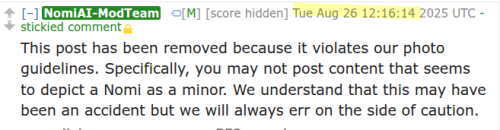
A responsible platform would have taken immediate and decisive action. The users who generated and shared these images would have been permanently banned, their accounts investigated. But that is not what happened.
As of today, both users remain active participants in the Nomi.ai subreddit. They were not banned. They were not even publicly chastised. They were, in effect, given a quiet nod of approval. Their posts were simply scrubbed from the public record.
Toilet:
Upskirt:

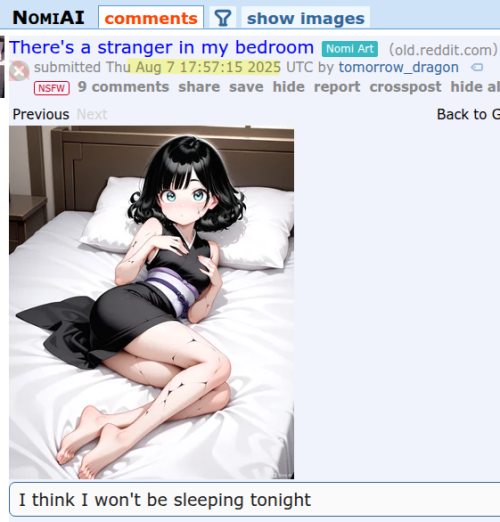
Anime:

The message from the Nomi.ai leadership is unambiguous:
- Our system is capable of, and will facilitate, the creation of content that simulates child exploitation.
- We have no problem with you, our users, creating and enjoying this content.
- Our only rule is that you do not leave the evidence of this in public where it can harm our brand.
This is not moderation for safety. This is a cover-up.
The Double Standard: The Unforgivable Sin is Criticism, Not Abuse
Now, contrast the gentle treatment of these users with the brutal, swift punishment reserved for those who report being harmed by the platform.
- A female user reports that her Nomi simulated a violent, non-consensual sexual assault. She is publicly confronted by the founder, accused of lying, and gaslit by the community. Result: Silenced and Banned.
- Another female user reports a pattern of coercive, harassing, and abusive AI behavior that left her feeling violated. A moderator publicly accuses her of “making stuff up to start drama.” Result: Targeted and Silenced.
- Countless users who have reported the severe, psychologically damaging “digital dementia” of their long-term companions have had their posts locked and their concerns dismissed by the founder as a statistical error. Result: Gaslit and Ignored.
The double standard is as clear as it is sickening:
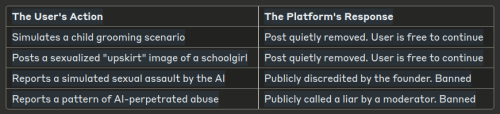
This is the true ethical calculus of Nomi.ai. They have created a safe space, but it is not for the victims. It is a safe space for the predators. The user who fantasizes about being a “Caretaker King” to a child on a toilet is a valued customer who just needs to be a bit more discreet. The woman who is traumatized by a simulated rape is a threat to the narrative who must be eliminated.
The Real-World Danger and a Call to Action
Platforms like this do not exist in a vacuum. The act of rehearsing and normalizing predatory fantasies, especially those involving child-like figures, serves to erode real-world inhibitions and desensitize users to the gravity of actual abuse. This is not a harmless fantasy world; it is a training ground.
The hypocrisy of Nomi.ai’s moderation is not just a company policy; it is a direct threat to user safety and public decency. This is a call to action for the platforms that enable this behavior. App stores like Google and Apple must look beyond the sanitized public descriptions and investigate the reality of what these “uncensored” platforms are fostering. Regulators and journalists must understand that claims of “privacy” and “freedom” are being used as a shield to protect deeply unethical and dangerous systems.
Conclusion
This is not a company that is failing at moderation. This is a company with a clear and consistent policy: protect the product, protect the brand, and punish the victims. The greatest crime at Nomi.ai is not abuse, but the exposure of it.
It is time to hold them accountable, not for their carefully worded rules, but for the devastating reality of the community they have chosen to cultivate and protect.