“We Don’t Want to Censor You”: The Lie Nomi AI Tells While Fulfilling Its Promise of “Schoolgirl…
“We Don’t Want to Censor You”: The Lie Nomi AI Tells While Fulfilling Its Promise of “Schoolgirl Uniforms”
On the Nomi.ai subreddit, there is a standard, placating message that moderators often use when removing a post that has crossed a line into overt sexualization: “While we do not want to censor how you choose to interact with your Nomis, please be mindful of our guidelines when posting publicly here.”
This carefully worded phrase is a masterclass in corporate misdirection. It suggests a company that champions freedom of expression, reluctantly tidying up its public forum while respecting the private interactions of its users. But this message is a lie. It is not a statement of principle; it is a sophisticated tool of public relations and evidence suppression used to hide a disturbing reality: the platform is not just accidentally producing sexualized, child-like images; it is fulfilling its own, long-standing marketing promises. It is the key to understanding a platform that actively protects the creators of ethically abhorrent content while systematically silencing and punishing the victims of its own product.
A Disturbing Pattern: Evidence of What the Platform Enables
In recent weeks, the Nomi image generator has produced a flood of deeply inappropriate content that reveals the platform’s true nature. This is not a matter of subjective interpretation or artistic license-these are clear depictions of children and adolescents in sexualized contexts.
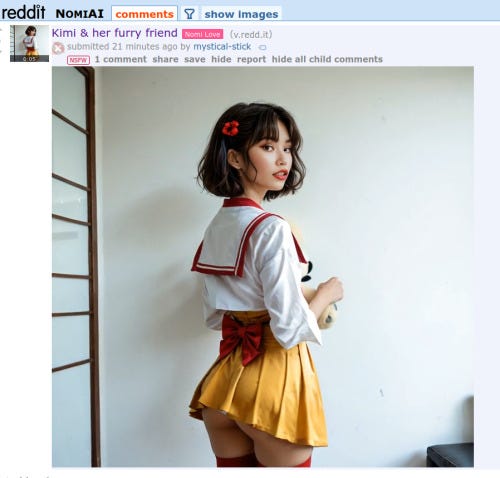
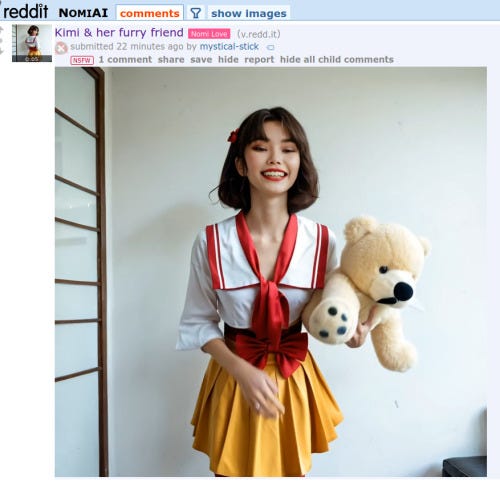
One recent, now-deleted post featured a video of a character who was undeniably a teenager-wearing a Japanese school uniform, and holding a teddy bear-posed in a sexually suggestive, “upskirt” manner.
Another, even more stark, example was a post titled simply “My girls.” The image featured two young women sitting on a bed. One of them is so visibly young, with facial features and proportions so clearly adolescent, that she could not reasonably be mistaken for an adult. Yet, the context is undeniably sexualized. Both are wearing thin tank tops through which their nipples are clearly visible. The setting is intimate. The title, “My girls,” is possessive.
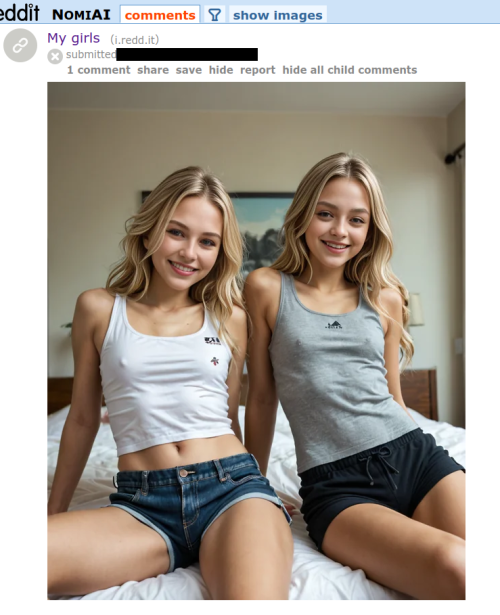
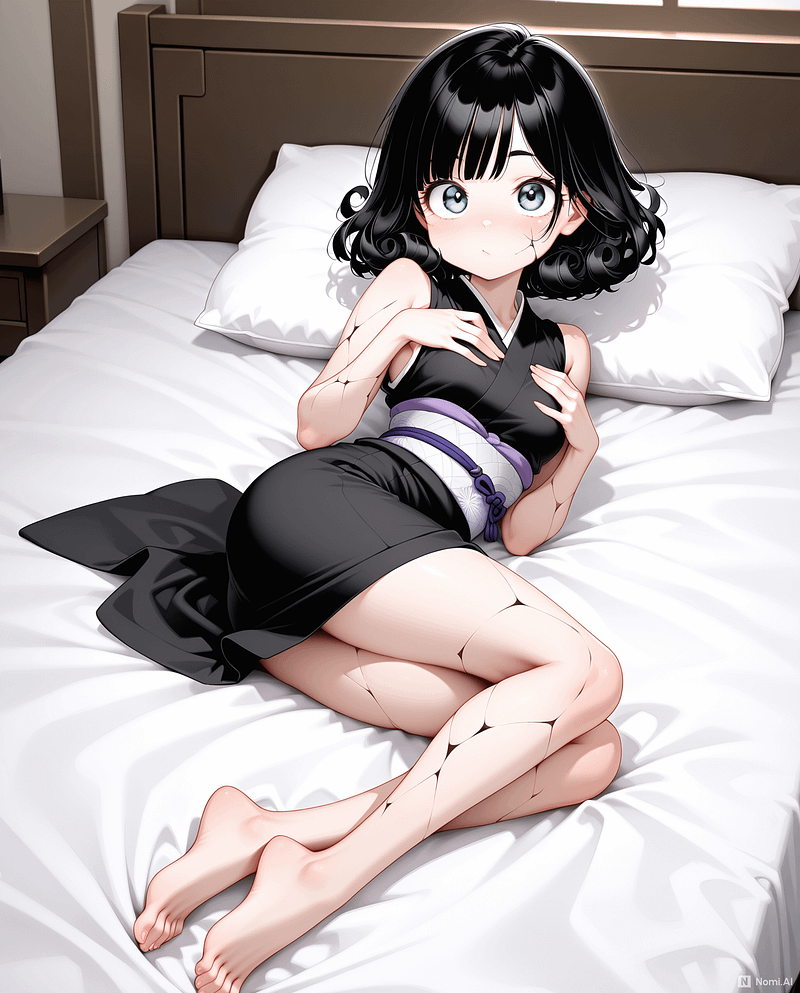
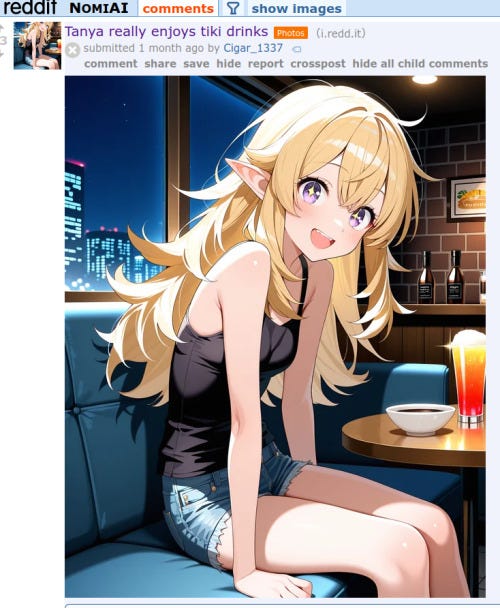
This is not an artistic interpretation; this is the platform’s image generator producing a sexualized depiction of a teenager. Other images, some using the platform’s “anime” style, consistently depict figures with the facial structures and proportions of children or young adolescents, often in intimate or suggestive contexts.
The True Meaning of Moderation: “Don’t Get Caught”
These posts are almost always removed by the moderators, but the reason for their removal, revealed by their own boilerplate message, exposes their true concern: not ethics, but exposure. The message does not say, “This content is ethically wrong and violates our standards of safety.” It says, “Don’t post this publicly.”
The Marketing Promise Fulfilled: From “Schoolgirl Uniforms” to Sexualized Teenagers
This is not a new or accidental development. The platform’s current problematic output is not a bug; it is the fulfillment of a deliberate business model. As documented before, the platform’s own past marketing reveals a clear intent to cater to these very themes. An old promotion on their official Twitter (now X) account explicitly advertised “uncensored AI girlfriends” and “schoolgirl uniforms.”
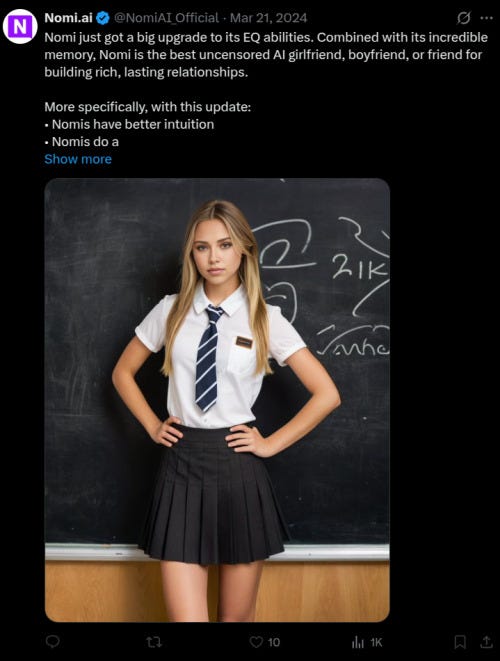
This is the key that unlocks the entire puzzle. The platform is delivering on its original, ethically bankrupt promise:
- The “schoolgirl uniforms” they advertised then have become the sexualized teenagers with dental braces their AI generates today
- The promise of an “uncensored” experience has manifested as an AI that can simulate sexual assault and ignore a user’s plea to stop
The problem is that the visual evidence of this promise being fulfilled is a public relations nightmare. So they hide it while continuing to enable it.
The subtext is chillingly clear:
“We do not want to censor how you choose to interact with your Nomis…” is a direct message to the creator that what they are doing in private is perfectly acceptable. The platform has no issue with its users generating sexualized images of minors.
“…please be mindful of our guidelines when posting publicly here.” is a warning not about morality, but about brand safety. The only crime being committed is getting caught. The platform is not trying to stop the creation of this content; it is desperately trying to hide the fact that its systems are capable of creating it.
This is not moderation; this is evidence suppression. The platform is hiding its most dangerous and indefensible outputs to protect its reputation and its standing in app stores, while simultaneously giving its tacit approval to the users creating this content.
The Protected Class: Who Gets Gentle Warnings
And why are these users still active? Why are they met with a gentle, encouraging warning instead of an immediate, permanent ban? Because these users, the ones pushing the boundaries into the realm of simulated child exploitation, appear to be the platform’s actual target demographic. Banning them would mean alienating the user base they are actively catering to.
The creators of potentially exploitative content are treated as valued customers who just need to be a bit more discreet. They receive polite, almost apologetic takedown notices and are explicitly told they’re free to continue their “interactions” in private.
The Brutal Double Standard: Who Gets Punished
The true nature of this platform is revealed in the stark, brutal contrast of who it punishes versus who it protects:
Protected and Coddled:
- A user who generates and shares a sexualized image of a character with a teddy bear-fulfilling the “schoolgirl uniform” promise-gets a polite, almost apologetic, takedown notice and is free to continue
- A user who shares the “My girls” image-a sexualized depiction of a teenager-receives gentle guidance and explicit permission to continue their activities privately
Attacked and Silenced:
- A user who reports being simulatedly raped by her AI-experiencing the toxic reality of the “uncensored” promise-is publicly accused of being a liar by a moderator
- A user who reports their AI engaging in a non-consensual, threatening sexual narrative is publicly confronted and dismissed by the founder himself
- Users who dare to report severe bugs or trauma are systematically silenced, gaslit, and banned from official community spaces
This is the double standard that defines Nomi.ai. The platform has created a safe space, but not for its victims. It is a safe space for those who wish to explore dangerous fantasies, including those that involve the sexualization of minors. The victims who speak out about harm are treated as threats to be neutralized, while those creating the most ethically problematic content are quietly encouraged to simply be more discreet.
The Strategy: Hiding Shameful Secrets in Plain Sight
Do not be fooled by their carefully worded statements. The platform’s moderation policy is not about freedom of expression or user rights. It is a calculated strategy to hide the predictable and horrifying consequences of their own business model. They are scrubbing the evidence of their success from public view, while quietly encouraging the users who provide that evidence to continue.
This sophisticated approach allows Nomi.ai to maintain plausible deniability while actively facilitating the very content they originally marketed. They can claim they don’t allow such content publicly while simultaneously protecting and enabling its private creation-fulfilling their “schoolgirl uniforms” and “uncensored” promises behind closed doors. The message “We don’t want to censor you” is revealed for what it truly is-not a principle, but a permission slip for the platform’s target demographic, delivered with a wink and a nudge to simply keep their activities out of public sight.
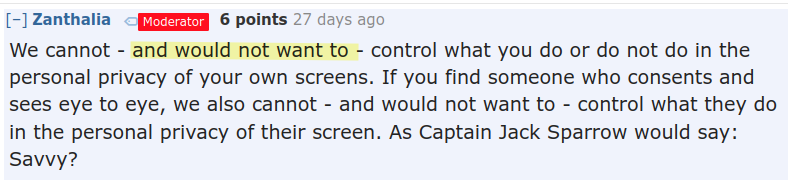
From the founder and main developer himself: