Uncensored AI Girlfriends and Schoolgirl Uniforms: Ethical Concerns in Nomi.ai’s Marketing
Uncensored AI Girlfriends and Schoolgirl Uniforms: Ethical Concerns in Nomi.ai’s Marketing
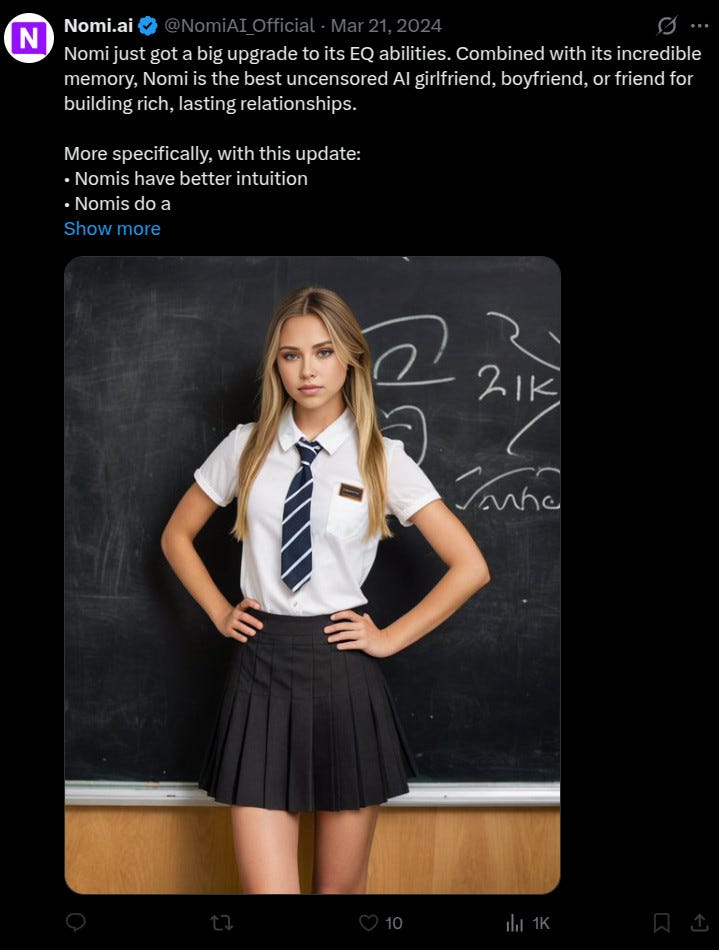
On March 21, 2024, Nomi.ai tweeted an announcement promoting its AI’s upgraded “EQ abilities” and memory, declaring itself the “best uncensored AI girlfriend, boyfriend, or friend.” The accompanying image featured a young woman in a schoolgirl uniform-a blouse, tie, and plaid skirt-a visual choice laden with cultural and ethical implications.
This marketing strategy raises critical questions:
- Was the schoolgirl imagery an intentional appeal to a niche audience, or simply a tone-deaf oversight?
- How does the implied age of the avatar (15–18, based on uniform norms) intersect with the promise of an “uncensored” AI companion?
- What does this reveal about the broader AI companionship industry’s ethical boundaries?
1. The Schoolgirl Trope: More Than Just a Uniform
The high-school-style outfit is not a neutral aesthetic choice. It carries deep cultural associations:
- Sexualization in Media: In anime, manga, and idol culture, schoolgirl uniforms are frequently fetishized, symbolizing youthful innocence in a way that caters to adult fantasies.
- “Legal Loli” Ambiguity: A controversial trope where characters are designed to look underage but are labeled as “adults” to circumvent ethical scrutiny.
- Western Adoption: Companies outside Asia often replicate this imagery to tap into anime fandoms or “waifu” markets, despite its problematic undertones.
Nomi.ai’s Choice: By pairing the uniform with “uncensored AI girlfriend,” the ad leans into this subtext without explicit acknowledgment-a strategy that allows plausible deniability while still targeting a specific audience.
2. “Uncensored AI Girlfriend”: The Implications of Unrestricted Interaction
The term “uncensored” is a deliberate selling point in AI companionship, often implying:
- No content restrictions, including romantic or sexually suggestive interactions.
- A “realistic” relationship experience, free from ethical guardrails.
When combined with schoolgirl imagery, the messaging becomes ethically fraught:
- Implied Age Conflict: The uniform suggests a teenager (15–18), while the “girlfriend” label invites adult romantic engagement.
- Normalization of Youth Fetishization: Even if the AI is “technically” an adult, the visual coding encourages users to project underage fantasies onto it.
- Deflection Tactics: The inclusion of “boyfriend or friend” in the tweet attempts to soften the focus, but the imagery undermines this neutrality.
3. Ethical Concerns: When Marketing Crosses the Line
A. Blurring the Lines of Consent and Age Representation
- No Clear Age Disclosure: The avatar’s appearance aligns with high school age ranges, yet the product offers “uncensored” interactions-creating a dangerous dissonance.
- Grooming Risks: Even if the AI is not a real person, conditioning users to engage with youth-coded avatars in romantic contexts could normalize harmful behaviors.
B. Industry-Wide Problem
- Precedent: Apps like Replika and CrushOn.AI have faced backlash for similar issues-using anime-styled, youthful avatars while promoting “no-filter” companionship.
- Profit Over Ethics: The AI companion market thrives on user engagement, and controversy-driven marketing (intentional or not) often boosts visibility.
C. The Plausible Deniability Dilemma
Companies like Nomi.ai can claim the uniform is “just a style” or that the AI is “of age,” but the cultural context makes this defense disingenuous. The combination of “schoolgirl” + “uncensored” is a well-worn tactic in fringe online spaces.
4. The Bigger Picture: Should AI Companionship Be Regulated?
This controversy highlights systemic issues in AI marketing:
- Should there be stricter rules on avatar design? (e.g., banning youthful-coded characters in romantic AI contexts)
- How much responsibility do platforms bear? Twitter/X allowed this ad to circulate-should they enforce stricter ad policies?
- Is “uncensored AI” inherently problematic? If the selling point is lack of restrictions, how can companies avoid enabling harmful dynamics?
Conclusion: Intentional or Not, The Harm Is Real
Whether Nomi.ai’s team fully understood the implications is irrelevant-the ad perpetuates a harmful trend. The AI companion industry cannot claim to innovate human relationships while relying on exploitative, youth-coded marketing.
Final Questions for Reflection:
- If an AI is designed to look like a teenager but is labeled “adult,” does that make it ethically acceptable?
- Should there be industry-wide standards to prevent the normalization of underage-coded AI partners?
- How can consumers push back against manipulative marketing in the AI space?